
10 Proven Sales Follow Up Email Templates for 2025 That Actually Get Replies

The average professional receives over 120 emails a day, and most sales follow-ups are deleted without a thought. The problem isn’t persistence; it’s the approach. Generic, self-serving emails like “just checking in” are ignored because they offer nothing of value. To break through the noise, your follow-up needs to deliver genuine insight, resonate with the prospect’s immediate challenges, and feel like a human-to-human business conversation, not a templated blast.
This guide moves beyond the basics, offering a curated collection of sales follow up email templates designed for specific, high-stakes scenarios. We’ll cover everything from reviving a cold lead and nudging a key decision-maker to handling objections and re-engaging a lost account. For each template, we will dissect the underlying strategy, provide proven subject lines, and give you actionable personalization cues to make every email count.
Our focus is on turning theory into practice. You’ll learn not just what to write, but why it works and how to implement it efficiently. We will show you step-by-step examples of how to automate the research, personalization, and sending process using tools like Sagekit, transforming a tedious manual task into a predictable revenue driver. To truly master effective follow-up communication, it’s beneficial to explore various powerful email features and tools that can streamline your process. Get ready to stop chasing prospects and start building conversations that close deals.
1. The Value-First Follow-Up
The Value-First Follow-Up is one of the most effective sales follow up email templates because it immediately shifts the focus from your needs to the prospect’s world. Instead of a generic “just checking in,” you lead with a piece of valuable information, a relevant insight, or a helpful resource tailored specifically to them. This approach builds instant credibility and demonstrates that you’ve done your homework.
This method is particularly powerful in B2B sales, where decision-makers are inundated with generic pitches. By providing value upfront, you position yourself as a resourceful partner rather than just another salesperson.
When to Use This Template
This follow-up is ideal for early-stage interactions, especially after an initial cold outreach or a first meeting that went cold. It’s also effective for re-engaging prospects who have shown interest but haven’t responded to previous nudges. It works because it respects their time and offers a reason to re-engage that benefits them directly.
Actionable Tips for Success
- Automate Research: Use web scraping tools or create a Sagekit workflow to monitor target companies for news, press releases, or new hires. This ensures your insights are timely and relevant.
- Leverage LinkedIn: Reference a prospect’s recent post, a company milestone, or a shared connection’s activity. For example, “I saw your company just announced its Series B funding - congratulations! This often brings new scaling challenges for data infrastructure…”
- Track What Works: Monitor which types of insights (e.g., competitor news, industry data, tech stack analysis) generate the highest open and reply rates. Use this data to refine your outreach strategy.
Pro-Tip: Use generative AI to quickly summarize a recent industry report or a prospect’s blog post, then use that summary to craft a highly personalized and insightful opening line for your follow-up email. This saves time while maximizing impact.
2. The Social Proof Follow-Up
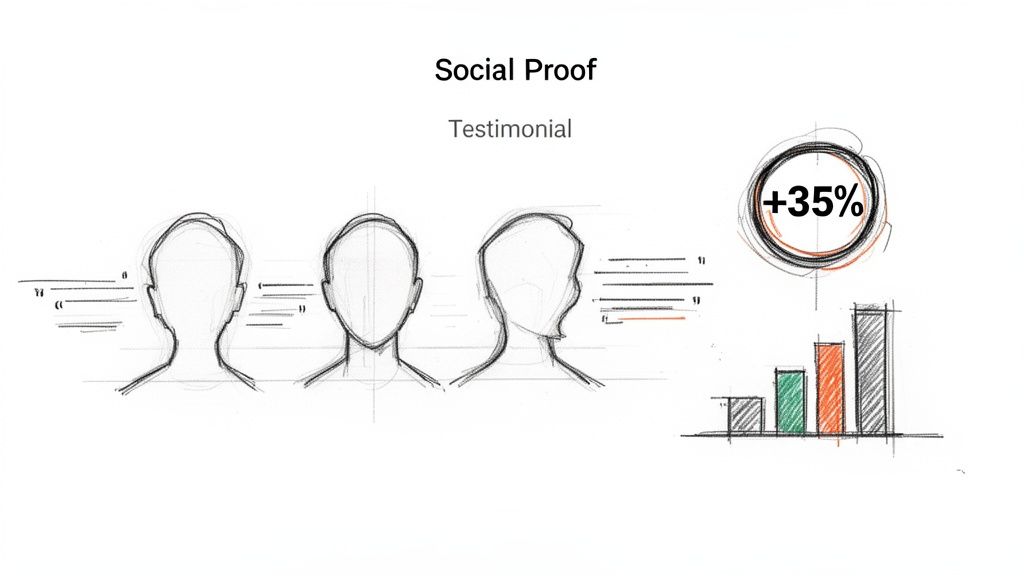
The Social Proof Follow-Up is one of the most persuasive sales follow up email templates because it leverages the power of peer validation. Instead of telling a prospect your solution works, you show them it works for others just like them. By highlighting customer testimonials, impressive case study results, or success stories from similar companies, you build trust and overcome natural skepticism.
This approach effectively answers the prospect’s unspoken question: “Has a company like mine succeeded with this?” It shifts the conversation from your claims to tangible, real-world impact, making your solution feel like a proven and safe choice. For example, a marketing agency could showcase a 35% ROI improvement for a client in the same industry.
When to Use This Template
This template is perfect for mid-funnel prospects who understand your offering but are hesitant to commit. It is especially powerful after a product demo or a pricing discussion when the prospect is evaluating their options and weighing the risks. It provides the final nudge needed to build confidence and move them toward a decision.
Actionable Tips for Success
- Segment Your Proof: Categorize your case studies and testimonials by industry, company size, and specific use case. This allows you to send the most relevant proof point to each prospect, maximizing its impact.
- Automate Selection: Create a Sagekit workflow that uses logic to match a prospect’s profile (e.g., industry = SaaS, size = 50-200 employees) with your best-fitting case study, then dynamically inserts the key metric into your email.
- Extract Key Metrics: Don’t just send a link. Pull the most compelling statistic directly into the email body, such as “Our client, [Similar Company], achieved a 40% reduction in support ticket response times.” This grabs attention immediately.
Pro-Tip: A/B test different formats of social proof. For one segment, send a short, punchy quote from a happy customer. For another similar segment, send a link to a full case study with a key metric. Track which format generates more engagement to optimize your follow-up strategy.
3. The Problem-Agitate-Solve (PAS) Follow-Up
The Problem-Agitate-Solve (PAS) Follow-Up is one of the most compelling sales follow up email templates because it taps directly into your prospect’s pain points. It starts by identifying a specific problem they likely face, agitates the consequences of leaving that problem unsolved, and then smoothly presents your product as the ideal solution. This framework creates an emotional connection by showing you understand their challenges on a deeper level.
This method is highly effective for prospects who may not yet realize the full extent of a problem or haven’t prioritized finding a solution. By clearly articulating the pain and its impact, you build a strong business case for your offering and create urgency.
When to Use This Template
This follow-up is perfect for prospects who have gone cold after an initial discovery call or for re-engaging leads who fit your ideal customer profile but haven’t responded. It works exceptionally well when you can pinpoint a specific, industry-relevant challenge, such as sales teams losing hours to manual lead qualification or operations teams struggling with chaotic spreadsheet management.
Actionable Tips for Success
- Segment by Pain Point: Use your CRM data to segment prospects by their most likely challenges. Create a tailored PAS structure for each segment to ensure maximum relevance and impact.
- Focus the Agitation: Keep the “agitate” section brief and powerful, ideally just two to three sentences. The goal is to highlight the consequences, not to overwhelm or sound overly negative. For example, “This often leads to missed opportunities and inaccurate forecasting…”
- Automate Problem Identification: Create a Sagekit workflow that analyzes company size, industry, and job titles to automatically insert industry-specific problems into your templates, saving time while personalizing at scale.
Pro-Tip: Use web search and research tools to find recent articles or reports about common pain points in your target industry. Referencing a specific statistic or quote in the “problem” section adds immense credibility to your follow-up.
4. The Multi-Channel Touch Follow-Up
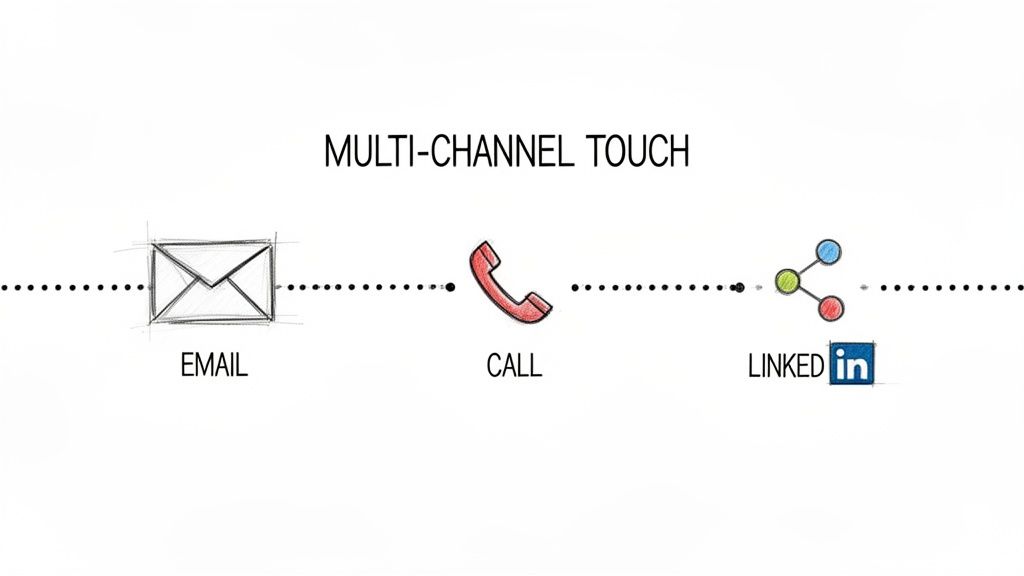
The Multi-Channel Touch Follow-Up recognizes that your prospect’s inbox is just one of many digital spaces they occupy. This strategy expands beyond email to create a coordinated sequence of touchpoints across channels like LinkedIn, phone calls, and even SMS. Each touch reinforces the message of the last, creating a persistent but non-intrusive presence that significantly increases the likelihood of engagement.
This approach is highly effective because it meets prospects where they are most active. Instead of being another unread message in a crowded inbox, a well-timed LinkedIn connection request or a brief, relevant voicemail can cut through the noise. This method is a core component of modern sales follow up email templates because it acknowledges the reality of today’s fragmented communication landscape.
When to Use This Template
This follow-up is perfect for high-value prospects or strategic accounts where a deeper level of engagement is required. It’s particularly useful after an initial meeting or demo when you need to maintain momentum. It also works well for re-engaging leads who have gone quiet after showing strong initial interest, as a different channel might be what’s needed to get their attention.
Actionable Tips for Success
- Coordinate Your Cadence: Design workflows that trigger actions across channels. For example, send an initial email, schedule a LinkedIn connection request for two days later, and then trigger a follow-up email that references your LinkedIn activity.
- Integrate and Notify: Connect your automation platform with team chat tools like Slack. This can send you a notification when a prospect opens your email, signaling the perfect time for a manual phone call. You can find more details about setting this up in our guide to sending automated emails from Gmail.
- Track Engagement Holistically: Use a centralized system to monitor all interactions. Log email opens, LinkedIn acceptances, and manual call notes in one place to get a complete picture of the prospect’s engagement level and inform your next move.
- Set Frequency Caps: To avoid overwhelming a prospect, set clear rules for your outreach. A good rule of thumb is a maximum of 3-4 touches across all channels within a single week.
Pro-Tip: Create templates for each channel that reference previous touches for a cohesive experience. For example, your LinkedIn connection request could say, “Hi [Name], I just sent you an email with some thoughts on [Topic]. Would love to connect here as well.”
5. The Question-Based Follow-Up
The Question-Based Follow-Up is one of the most engaging sales follow up email templates because it shifts the dynamic from a one-way pitch to a two-way conversation. Instead of pushing information, you pull the prospect in by asking a thoughtful, open-ended question about their situation, priorities, or challenges. This approach is disarming and encourages a response by appealing to their expertise and desire to be heard.
This method is highly effective for re-engaging prospects because it’s not overtly salesy. It shows genuine curiosity and positions you as a consultant aiming to understand their world, which helps build trust and uncover valuable information that can be used to tailor your pitch later on. It’s also an excellent way to qualify leads and disqualify tire-kickers early in the process.
When to Use This Template
This follow-up works best after an initial conversation or demo when you need to understand the prospect’s specific pain points more deeply. It is also a powerful tool for re-engaging a cold lead or someone who has gone silent. For example, a consultant might ask about a prospect’s current processes, or a SaaS rep could inquire how a team is currently solving a particular problem their software addresses.
Actionable Tips for Success
- Personalize Your Questions: Analyze a prospect’s LinkedIn activity or recent company announcements. Use this insight to formulate a question relevant to their current context, like, “I saw your team recently hired a new Head of Operations; how is that shifting your priorities for Q4?”
- Keep It Concise: Limit yourself to one or two strategic questions at most. Overloading a prospect with questions significantly reduces the likelihood of a response. The goal is to start a dialogue, not conduct an interview.
- Log and Leverage Responses: Store any answers you receive directly in your CRM or an Airtable base. This information is gold for personalizing future interactions and demonstrating that you listen and remember key details.
Pro-Tip: Use a generative AI tool to analyze a prospect’s company blog or a recent industry report they shared. Prompt the AI to generate three open-ended questions related to the challenges mentioned in the text. This gives you high-quality, relevant questions in seconds.
6. The Educational Content Follow-Up
The Educational Content Follow-Up is a highly effective entry in any playbook of sales follow up email templates because it establishes your authority and helpfulness. Instead of asking for a meeting, you provide genuinely useful content like a guide, report, webinar, or case study that addresses a prospect’s specific pain point. This approach builds trust and positions you as a knowledgeable resource, not just a vendor.

This method shines when you want to nurture a lead over time without being pushy. By educating your prospect, you keep your brand top-of-mind and demonstrate a deep understanding of their industry challenges. For example, a B2B SaaS company might share an industry benchmark report, while an agency could offer a case study framed as an educational deep dive.
When to Use This Template
This template is perfect for mid-funnel prospects who have shown initial interest but aren’t ready to buy. It’s also a powerful tool for re-engaging cold leads or nurturing contacts from a trade show. Use it when you need a valid reason to reach out that isn’t just another sales pitch. It works because it offers tangible value and invites engagement on their terms.
Actionable Tips for Success
- Create a Content Tagging System: In your CRM or a tool like Sagekit, tag all your content by industry, role, and challenge (e.g., #manufacturing, #COO, #scalability). This allows you to automatically match and send the most relevant asset to each prospect.
- Track Content Engagement: Use UTM parameters or tracked links in your emails to see who clicks on your resources. High engagement on a specific topic is a strong buying signal that tells you exactly what to discuss in your next follow-up.
- Layer Your Content: Don’t just send one piece. Create a multi-touch sequence that delivers different educational assets over time, guiding the prospect through the awareness and consideration stages of their journey.
Pro-Tip: Combine your educational content with a question-based CTA. For instance, “Here’s our latest guide on streamlining team workflows. Curious, have you explored how AI tools for productivity can help you solve similar challenges?” This transitions the conversation from passive learning to an active sales discussion.
7. The Urgency/Scarcity Follow-Up
The Urgency/Scarcity Follow-Up is a powerful psychological trigger that prompts prospects to act. This type of sales follow up email template works by introducing a time-sensitive element, such as a limited-time offer, an expiring discount, or exclusive access that won’t be available for long. When used ethically, it overcomes inertia and gives a hesitant prospect a compelling reason to make a decision now rather than later.
This approach is highly effective because it leverages the principle of loss aversion. People are more motivated by the fear of losing an opportunity than by the prospect of gaining something of equal value. By highlighting what they stand to miss, you create a legitimate reason for them to prioritize your email and respond.
When to Use This Template
This template is best used later in the sales cycle when a prospect has shown clear interest but has stalled in the decision-making phase. It’s perfect for nudging someone who has received a proposal or pricing but has gone quiet. Examples include year-end software promotions with specific discount expirations, limited spots in an upcoming training cohort, or a special retainer rate that expires at the end of the month.
Actionable Tips for Success
- Create Legitimate Deadlines: The urgency must be genuine. Use a shared calendar or a spreadsheet to track offer expiration dates. This ensures your claims are authentic and helps you manage follow-ups effectively.
- Automate Countdown Language: Build workflows that calculate the days remaining for an offer. Automatically insert dynamic language like “Only 3 days left at this rate” to increase the impact without manual effort.
- Schedule for Peak Times: Send urgency-based emails at optimal times when prospects are most likely to see and act on them. Tuesday through Thursday, late morning, often yields the best results.
- Combine with Value: Don’t rely on urgency alone. Reinforce the value of your offer and pair the scarcity with social proof or a case study to create a more powerful and persuasive message.
Pro-Tip: Track the performance of your urgency-based emails separately from other follow-ups. Monitor reply rates and conversion rates to measure their direct impact. This data will help you refine your offers and avoid overusing the tactic, which can diminish its effectiveness.
8. The Check-In/Relationship-Building Follow-Up
The Check-In/Relationship-Building Follow-Up is one of the most underrated sales follow up email templates because its primary goal is not to sell, but to connect. This approach prioritizes genuine, human-to-human interaction over a sales pitch, focusing on the prospect’s world, their challenges, and their successes. It positions you as a thoughtful industry contact who cares about their long-term success, not just a short-term sale.
This method is crucial for long sales cycles and high-touch accounts where trust and rapport are paramount. By consistently showing up with genuine interest and value-adds that aren’t tied to your product, you build a strong foundation that pays dividends when the prospect is finally ready to buy. It’s about playing the long game.
When to Use This Template
This follow-up is perfect for nurturing high-value prospects over several months or even years. Use it to stay top-of-mind with past clients, re-engage leads who went quiet for non-sales reasons, or strengthen relationships with key decision-makers in target accounts. It works because it’s unexpected and breaks the cycle of constant “asks,” making your eventual sales message more impactful.
Actionable Tips for Success
- Document Personal Details: Use Notion or your CRM to note personal details from conversations, like hobbies, upcoming vacations, or professional milestones. Referencing these later shows you were truly listening.
- Share Relevant Content: Set up a Sagekit workflow to monitor industry news or a prospect’s company updates. When something relevant pops up, share it with a brief note like, “Saw this article on AI in logistics and thought of our conversation.”
- Offer Strategic Introductions: Leverage your network to connect your prospect with someone who can help them, without expecting anything in return. This is a powerful way to provide immense value and build social capital.
- Set Relationship Cadences: Create reminders to check in with key contacts every 4-6 weeks. A simple, no-pressure email can keep the connection warm and ensure you’re remembered.
Pro-Tip: Remember a specific challenge they mentioned on a previous call. A few weeks later, follow up with a message like, “Hey [Name], I remember you were working on improving team onboarding. I just came across this case study on how [Company] solved it and thought you might find it useful. No strings attached!“
9. The Objection-Handling Follow-Up
The Objection-Handling Follow-Up is one of the most proactive sales follow up email templates you can use. Instead of waiting for a prospect to ghost, this template directly addresses a known or suspected concern that is preventing them from moving forward. It tackles hesitation head-on with specific information, evidence, or clarification, turning a potential roadblock into a reason to re-engage.
This method demonstrates empathy and confidence. By showing you understand their potential concerns (e.g., budget, implementation time, existing vendors) and have a clear answer, you build trust and position your solution as the most well-thought-out option. It’s a powerful way to keep a deal from stalling due to unvoiced fears.
When to Use This Template
This follow-up is perfect after a discovery call or demo where the prospect mentioned a specific concern, even in passing. It’s also highly effective when you suspect a common objection based on the prospect’s role or industry. For example, if you know CFOs are always focused on ROI, you can proactively address budget concerns with an ROI-focused email.
Actionable Tips for Success
- Log Objections: Keep a simple Airtable or Google Sheet to track common objections raised during calls. Use this data to create a library of pre-written templates that address each one.
- Automate Evidence: When a specific objection like “implementation takes too long” is logged in your CRM, use a Sagekit workflow to automatically pull a relevant case study or data sheet on your quick onboarding process and attach it to your draft.
- Build a Decision Tree: Create a workflow that sends a specific follow-up based on the noted objection. If a prospect mentioned budget, send an ROI calculator. If they mentioned integration, send a link to your technical documentation.
- Be Direct with Your Ask: After addressing the objection, follow up with a highly specific call to action. For example, “Does a quick 10-minute call on Tuesday to walk through our integration process sound helpful?”
Pro-Tip: Use generative AI to help draft nuanced responses to complex objections. Feed it the prospect’s concern and key data points about your solution, then ask it to generate a concise, reassuring email. Refine the output to match your brand’s voice for a perfect blend of efficiency and personalization.
10. The Win-Back/Re-Engagement Follow-Up
The Win-Back/Re-Engagement Follow-Up is a strategic approach to reviving conversations with prospects who have gone cold after a period of engagement. Instead of letting a promising lead languish in your CRM, this template acknowledges the time that has passed and introduces a fresh, compelling reason to reconnect. It’s one of the most vital sales follow up email templates for maximizing the value of your existing lead database.
This method works because it recognizes that a prospect’s needs and priorities change over time. What wasn’t a fit six months ago might be their top priority today. By re-engaging with new value, such as a major product update, a new service offering, or relevant industry insights, you can restart the conversation on a stronger footing.
When to Use This Template
This template is perfect for targeting leads who have been unresponsive for 90 days or more. It’s especially effective for SaaS companies re-engaging users who completed a trial but never converted, or for agencies reaching out to prospects from a previous RFP cycle with an updated portfolio. The key is to have a legitimate “new” reason to reach out beyond just checking in. When facing stalled conversations or lost deals, an effective email templates comeback kit can be invaluable for re-engaging prospects.
Actionable Tips for Success
- Segment Your Silent Leads: Use your CRM to filter for prospects with no contact in the last 90-180 days. Segment them by the original reason for their interest or the reason they went cold (e.g., budget, timing, missing features) to tailor your re-engagement angle.
- Do Your Reconnaissance: Before reaching out, research what’s new with their company. Did they recently receive funding, hire a new executive, or launch a new product? Use this intel to make your message highly relevant and timely.
- Craft a New Sequence: Don’t just re-use your old outreach emails. Create a dedicated win-back sequence with a fresh offer, a different value proposition, or even a different messenger (e.g., have a manager reach out). For more ideas, you can explore strategies for automated lead generation.
Pro-Tip: Set up a Sagekit workflow to automatically trigger a win-back sequence when a contact in your CRM has had no logged activity for a specific period, like 120 days. This ensures no valuable, once-warm leads ever fall through the cracks permanently.
Comparison of 10 Sales Follow-Up Email Templates
| Strategy | 🔄 Implementation Complexity | ⚡ Resource Requirements | 📊 ⭐ Expected Outcomes | Ideal Use Cases | ⭐ Key Advantages & 💡 Quick Tip |
|---|---|---|---|---|---|
| The Value-First Follow-Up | Moderate — requires targeted research and personalization | Moderate ⚡ — time for research; automatable with AI/web scraping | Higher open & response rates; quality leads ⭐⭐⭐⭐ 📊 | B2B cold/warm outreach; overwhelmed prospects | Positions sender as expert; reduces spam perception. Tip: Automate research and use concise, genuinely relevant insights. |
| The Social Proof Follow-Up | Low–Moderate — needs curated case studies and matching logic | Medium ⚡ — maintain a case study library and segmentation data | Persuasive; reduces perceived risk; increases conversions ⭐⭐⭐⭐ 📊 | Pros skeptical of claims; proof-driven buyers | Demonstrates measurable outcomes; preempts “prove it” objections. Tip: Match case study by industry/size. |
| The Problem-Agitate-Solve (PAS) Follow-Up | Moderate — craft tailored problem + agitation + solution flow | Moderate ⚡ — research on pain points per segment | High engagement for problem-aware prospects; drives reflection ⭐⭐⭐⭐ 📊 | Pros unaware of their problem; re-engagement campaigns | Psychologically persuasive; guides to action. Tip: Keep agitation short (2–3 sentences) and specific. |
| The Multi-Channel Touch Follow-Up | High — coordinates cadence across multiple platforms and tracking | High ⚡ — tools, compliance, and cross-platform integrations required | Highest reach and response when executed well ⭐⭐⭐⭐⭐ 📊 | Competitive markets; enterprise sales; high-value deals | Multiple contact points increase visibility; accommodates preferences. Tip: Respect DNC rules and set frequency caps. |
| The Question-Based Follow-Up | Low — simple to write but requires thoughtful personalization | Low–Moderate ⚡ — time to craft 1–3 targeted questions; CRM logging | Good for qualification and initiating dialogue ⭐⭐⭐ 📊 | Discovery calls; consultative sales; information gathering | Lowers defensiveness; yields qualification insights. Tip: Ask 1–3 specific questions and log responses. |
| The Educational Content Follow-Up | Moderate — requires content creation and tagging system | High ⚡ — investment in quality content and curation | Builds credibility and trust; longer sales cycle but durable results ⭐⭐⭐ 📊 | Thought leadership; long sales cycles; top-of-funnel nurturing | Reusable assets that lower pressure; positions as helpful resource. Tip: Tag content by industry/role and track engagement. |
| The Urgency/Scarcity Follow-Up | Low–Moderate — message is simple but requires legitimate deadlines | Low–Moderate ⚡ — calendar/offer management and tracking | Strong short-term conversion lift; risk if overused or inauthentic ⭐⭐⭐⭐ 📊 | Seasonal promos, limited seats, end-of-period offers | Drives immediate action; effective for fence-sitters. Tip: Use real, trackable deadlines and limit frequency. |
| The Check-In/Relationship-Building Follow-Up | Moderate — requires authentic personalization and tracking | Moderate–High ⚡ — time investment; CRM/notes to remain genuine | Builds long-term trust and advocacy; slow ROI ⭐⭐⭐ 📊 | High-value accounts; long sales cycles; account management | Fosters genuine relationships and future referrals. Tip: Schedule periodic reminders and reference past conversations. |
| The Objection-Handling Follow-Up | Moderate — must identify specific objections and prepare evidence | Moderate ⚡ — maintain templates, case studies, and decision trees | Effectively removes barriers and converts fence-sitters ⭐⭐⭐⭐ 📊 | Post-demo follow-ups; prospects with known hesitations | Demonstrates listening and trustworthiness. Tip: Log objections and use targeted templates with a clear next step. |
| The Win-Back/Re-Engagement Follow-Up | Moderate — research past interactions and craft a new angle | Moderate ⚡ — analyze lapse reason; personalize re-engagement offers | Cost-effective revival of warm leads; variable success based on timing ⭐⭐⭐ 📊 | Lapsed prospects, inactive trials, past opportunities | Easier to convert than cold leads; often overlooked. Tip: Segment by reason for lapse and offer a fresh angle or incentive. |
From Templates to Systems: Your Next Move
We’ve explored a comprehensive arsenal of sales follow up email templates, moving far beyond generic messages into strategic, scenario-based communication. From the Value-First approach that builds trust to the Urgency/Scarcity tactic that drives decisions, you now have the foundational scripts to engage prospects at every stage of the sales cycle.
The journey through these ten distinct follow-up strategies reveals a crucial, overarching truth: effective follow-up is not about finding one “perfect” email. It’s about building a responsive, adaptable system. The real power isn’t in the individual template; it’s in knowing precisely when to deploy the Problem-Agitate-Solve framework versus a simple Relationship-Building check-in, or when to pivot from email to a Multi-Channel touchpoint on LinkedIn.
Key Takeaways for Building Your Follow-Up Engine
Mastering these templates requires a shift in mindset. Instead of viewing follow-up as a series of isolated tasks, you must see it as an integrated workflow. Here are the core principles to internalize:
- Context is King: The most effective follow-up is always relevant. The best sales follow up email templates are those personalized to the prospect’s last interaction, their known pain points, and their position in the buying journey. A post-demo follow-up is fundamentally different from a cold re-engagement email.
- Persistence Requires Variety: Sending the same “just checking in” email repeatedly is the fastest way to get ignored or marked as spam. A successful sequence mixes value-driven content, insightful questions, social proof, and gentle nudges to keep the conversation fresh and engaging.
- Automation Amplifies, It Doesn’t Replace: The goal of automation is not to remove the human element but to eliminate manual, repetitive work. It handles the scheduling, tracking, and initial outreach, freeing up your time for genuine personalization, strategic thinking, and high-value conversations. Manually tracking who needs which email on what day is a recipe for missed opportunities.
Your Action Plan: Turning Knowledge into Revenue
Having a library of sales follow up email templates is a great start, but true mastery comes from systematic implementation. Your next steps should focus on operationalizing these strategies so they become a consistent, reliable part of your sales process.
- Map Your Scenarios: Identify the top 5-7 most common scenarios in your sales cycle (e.g., after a discovery call, after sending a proposal, 30 days of no response).
- Assign Your Templates: Match the most appropriate templates from this article to each of those scenarios. Create a multi-step sequence for each, blending different approaches. For instance, a “no response” sequence might start with a Question-Based Follow-Up, then move to an Educational Content share, and finally a Win-Back attempt.
- Implement a System: This is the most critical step. Manually executing these sequences is inefficient and prone to error. Use a tool to build these workflows. The goal is to create a system where a prospect’s action (or inaction) automatically triggers the correct follow-up sequence, ensuring no lead ever falls through the cracks.
By transforming these individual templates into a cohesive, automated system, you move from reactive chasing to proactive, strategic engagement. This systematic approach is what separates top-performing sales professionals from the rest. It builds pipeline, shortens sales cycles, and ultimately, drives more revenue with less manual effort.
Ready to turn these proven sales follow up email templates into an automated revenue-generating machine? Sagekit helps you build, personalize, and automate entire follow-up sequences in minutes, so you can focus on closing deals, not just sending emails. Explore Sagekit and start building your unstoppable follow-up system today.